


Walt CormierLocksmith · Dayton, Ohio
Launch promo ends in00:00:00
Thirty-one years on the other side of the door

The Locksmith's Library

Four illustrated manuals on how houses are actually entered — the eight seconds on the sidewalk, the costume at the door, the three-quarter-inch screw in the strike plate — and the cheap fix for every one of them.

My name is Walt Cormier. I ran a locksmith shop in Dayton, Ohio for thirty-one years, and for eleven of them a good part of my work was the morning after — standing in a kitchen with a family who had not slept, answering the same question every time. How did he get in.

Nearly every time I could show them in under a minute, because it was the same handful of places over and over again. Almost nobody picks a lock. What happens is a man walks up a driveway on a Tuesday, knocks, and when nobody answers he kicks the door beside the knob and the frame comes apart, because it was held together with three-quarter-inch screws driven into soft pine.

These four books are that minute, written down. 734 illustrated pages, every fix with a real parts list, a real dollar figure, and an honest box at the end telling you what it does not do.

Real Voices

“I read the chapter on three-inch screws in The Burglar-Proof Home Manual on a Saturday morning and had every exterior door done before lunch. Four dollars. Thirty-one years of knowing that and nobody ever told me.”

Raymond K. Raymond K.58, Columbus, Ohio

“Trick 004 in 100 Tricks is the city water inspector. A man in a blue shirt stood on my porch three weeks later saying exactly that. I said the one sentence from the book and shut the door.”

Marie L. Marie L.46, Fort Wayne, Indiana

“I bought the collection for my mother, who lives alone. How to Stop Being an Easy Target gave her the card by the phone and the four o’clock lap. She calls me about it. She isn’t frightened — she’s organized.”

Tom B. Tom B.44, Louisville, Kentucky
4.9 / 5 stars · over 8,000 households have done the first Saturday
Get the Locksmith's Library — $68 $29.99
Instant download · Yours forever
Secure checkout by GumroadCardPayPalPDF · read anywhere
31Years in the trade
4Illustrated volumes
734Pages
$4The best fix in the set
I

Break-ins are not clever

They are a decision made on a sidewalk in about eight seconds, by somebody doing arithmetic with two terms in it.

There is a street I could take you to in Dayton where the houses are all the same. Eleven of them in a row, built by the same company in 1974. Between 2009 and 2014, four of those eleven were broken into. The other seven never were.

Same street. Same locks, more or less. Same kind of family inside. I worked on three of the four, and when I started paying attention to what made the difference, it was not the thing anybody expects. It was not that the four had worse deadbolts — two of them had better deadbolts than the houses on either side.

It was that the four had all told a stranger something, from the sidewalk, in the time it takes to walk past. The first had a storm door with two days of mail visibly stacked inside it at four in the afternoon. The second had a six-foot privacy fence with an unlatched gate on the side away from the neighbor. Everybody thinks a privacy fence is security. A privacy fence is privacy, and privacy is exactly what a man working on your back door wants.

He is not asking whether he can get into your house. He is asking whether yours is the easiest one in a three-minute walk.

That is an enormously easier problem to solve. You do not have to build a fortress. You have to be the wrong answer to four quick questions — and because everybody else on your street is doing almost nothing, being the wrong answer is cheap.

An alarm contract is forty dollars a month forever. A box strike is eighteen dollars once. Both are sold by the same industry, and you can guess which one gets advertised. I have nothing against alarms, and I say so in the chapters where they earn their keep. But I have watched too many people spend a thousand dollars on monitoring while the door frame their money was supposed to be protecting was still held together by the trim screws it shipped with.

That is the honest reason these books exist. The trade has known all of it for decades. Almost none of it has ever been explained to the people who own the houses, because there is no money in explaining it.

II

The Difference

What the security industry sells you, against what a locksmith would actually do on your house.

The usual adviceThe Locksmith's Library
Where it starts At the lock you can buy today At the curb, where the house gets chosen
What it costs $40 a month, forever, plus install $4 for the single highest-value fix in the set
Prices given “Call for a quote” Every part, at 2026 retail, to the dollar
On the people at the door Nothing — it only watches the door 100 costumes, stories and scripts, and what gives each away
What it admits Sells certainty Every chapter ends with a box on what the fix does not do
Who wrote it A marketing department A man who spent eleven years on the morning-after call
What you are left with A contract and a sticker A house that takes longer, makes more noise, and gets passed over
III

What’s Inside

The real contents of all four volumes. Every one is the illustrated first edition, 2026.

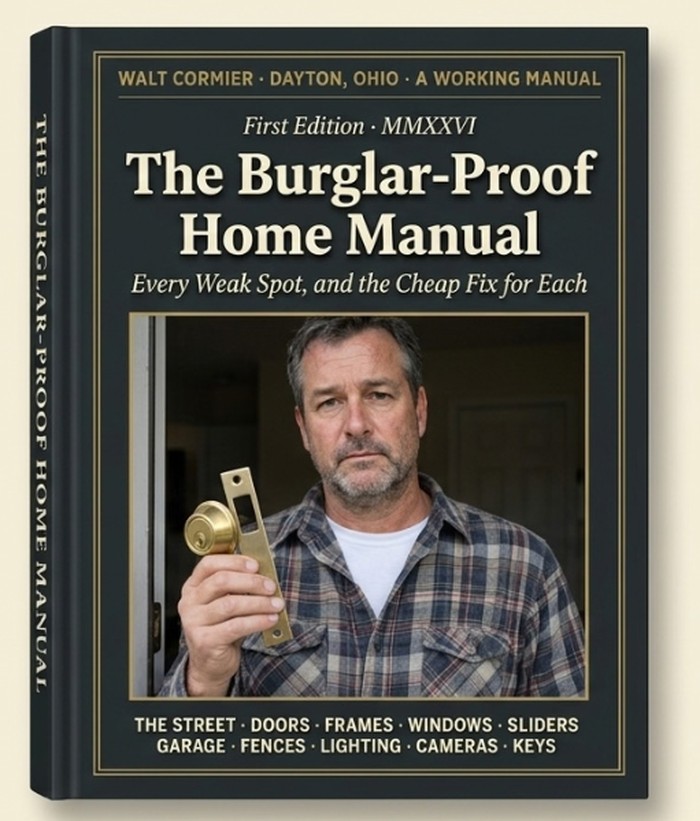
The Burglar-Proof Home Manual

The Burglar-Proof Home Manual

161 pages · 40 chapters · 7 sections · illustrated

Every Door, Window, and Weak Spot a Thief Checks First, and the Cheap Fix for Each.

The spine of the library. It starts at the curb and works inward — the street, the doors, the windows, the perimeter, light and eyes, keys and valuables, habits, and what to do afterwards. Each chapter opens with a house I was called out to, walks the job through the way one person walks another through it at their elbow, then gives you The Math — parts cost in 2026 dollars, time on the job, and the return measured in minutes of delay. Then The Limits, in a grey box, telling you what the fix does not do.

Contents
  • The Street — how a house gets chosen (ch. 1–5)
  • Doors — why they fail at the frame (ch. 6–11)
  • Windows — latches, sliders, film (ch. 12–16)
  • The Perimeter — garage, fences, ladders (ch. 17–21)
  • Light and Eyes — lighting, cameras, alarms (ch. 22–26)
  • Keys and Valuables — key control, safes (ch. 27–31)
  • Habits — the closing routine, going away (ch. 32–36)
  • After — if you hear someone inside (ch. 37–40)
  • Appendix A — The First Saturday
  • Appendix B — The Walk-Around Audit Sheet
  • Appendix C — The Materials Sourcing Sheet
  • Appendix D–E — Problem index & glossary
Get The Burglar-Proof Home Manual — $17 Instant download · or take all four for $29.99
100 Tricks Criminals Use To Get Inside

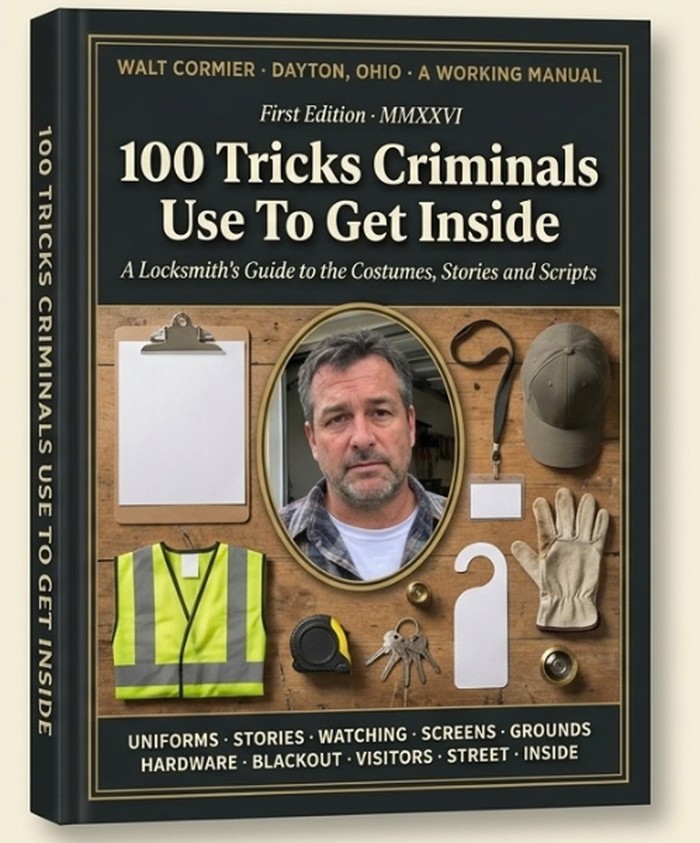
100 Tricks Criminals Use To Get Inside

198 pages · 100 tricks · 10 parts · illustrated

A Locksmith’s Guide to the Costumes, Stories, and Scripts That Get a Stranger Through Your Door.

Most of the doors I was called out to had nothing wrong with them. They were unlocked, or opened from the inside, or somebody had been let in through them — politely — by a person with no reason on earth to suspect anything. This is one hundred of those, in the order they tend to happen. Every trick gets How It Runs, What Gives It Away, What To Do, and a limits box. Nothing in it is a method for defeating a lock; every technique is described at the level you need to recognize it and stop it, and no further.

The ten parts
  • Uniforms — the meter reader, the cable tech, the gas leak
  • Stories — the lost dog, the broken-down car, “I used to live here”
  • Watching — the drive-by, the door hanger, the vacation post
  • Screens — the delivery text, the bank call, the grandchild
  • Grounds — the gate latch, the ladder, the garage release
  • Hardware — the strike plate and its short screws
  • Blackout — the unscrewed bulb, the cut line, the storm night
  • Visitors — the estimate walk-through, the bathroom detour
  • Street — the fob on the hall table, followed home from the bank
  • Inside — the first ninety seconds, and the return visit
Get 100 Tricks Criminals Use To Get Inside — $17 Instant download · or take all four for $29.99
25 Cheap Upgrades That Make Burglars Skip Your House

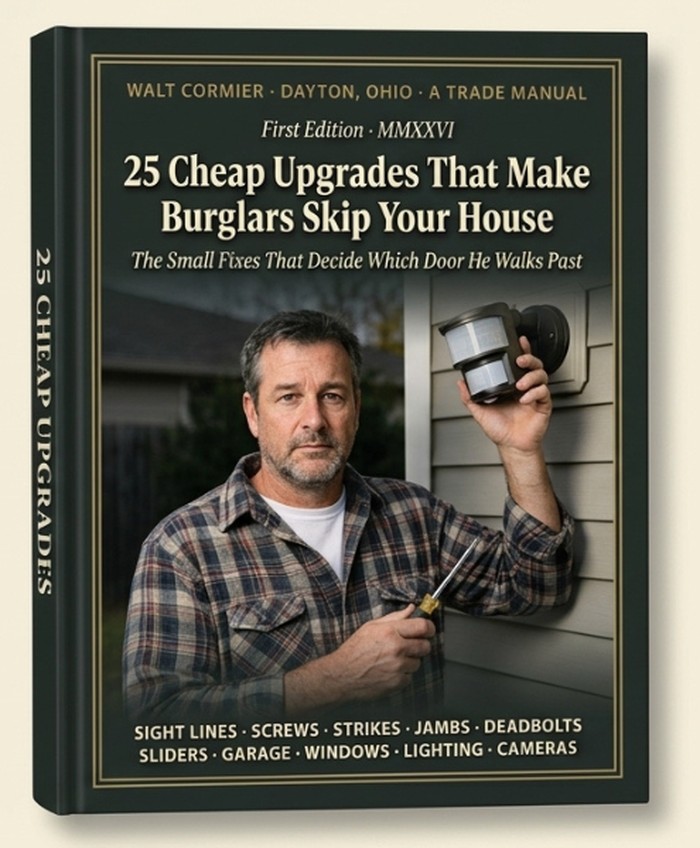
25 Cheap Upgrades That Make Burglars Skip Your House

189 pages · 25 upgrades · 6 sections · illustrated

The Locksmith’s Guide To The Small Fixes That Decide Which Door He Walks Past.

A trade manual. Under every chapter title is a strip with four figures on it: what the parts cost at 2026 retail, roughly how long the job takes, the tools you need on the bench before you start, and who the job is for. If it says you need to be comfortable with a drill and you are not, the chapter tells you what to hand to somebody else and roughly what that costs. Every chapter ends with The Math — the parts cost set against what the upgrade replaces or prevents, in dollars. If an upgrade could not survive that paragraph, it is not in the book.

The twenty-five, by section
  • The Street — sight lines, house numbers, the ladder (1–4)
  • The Front Door — three-inch screws, the box strike, jamb armor (5–10)
  • The Other Ways In — slider track, garage release, basement (11–14)
  • Windows — sash pins, security film, $3 alarms (15–18)
  • Light — where the motion light really goes (19–22)
  • Eyes and Noise — doorbell camera placement, gravel (23–25)
  • Appendix A — The First Weekend, at three budgets
  • Appendix B — The Walk-Through Sheet
  • Appendix C — The Shopping List, every part and price
  • Appendix D–F — If it already happened · If you rent · Glossary
Get 25 Cheap Upgrades — $17 Instant download · or take all four for $29.99
How to Stop Being an Easy Target

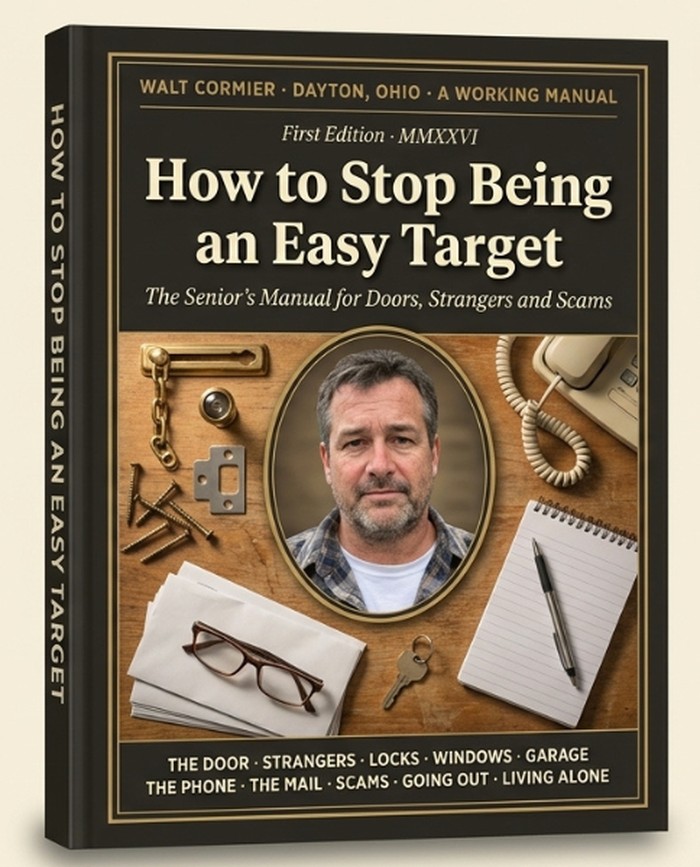
How to Stop Being an Easy Target

186 pages · 90 chapters · 7 sections · illustrated

The Senior’s Manual for Doors, Strangers, Scams, and Living Alone Without Fear.

Written for people living on their own, most of them past sixty-five, in houses they have been in a long time. Not because anybody past a certain age is weak — because a person living alone in a paid-off house is predictable, is usually home, usually answers the phone, and was raised in a country where you answered the door. Every script they use is built on that last part. The chapters are short on purpose: you should be able to read one with your coffee and do it that same morning. Most of them cost nothing.

Contents
  • The Door — the one rule, the peephole, the chain (1–13)
  • The House — the four o’clock lap, sliders, the garage (14–30)
  • The Phone — the card by the phone, the grandchild call (31–43)
  • The Mail — the credit freeze, the kitchen-table contract (44–55)
  • Out — the parking lot, the ATM, the three questions (56–67)
  • Alone — the neighbor who would notice, the daily check-in (68–80)
  • After — what to say on a 911 call, getting your nerve back (81–90)
  • Appendix A–E — The Four O’Clock Lap · The Card by the Phone · The Walk-Around Audit · Numbers Worth Having · The Emergency Folder
Get How to Stop Being an Easy Target — $17 Instant download · or take all four for $29.99
Take all four — $29.99
Instant download · Yours forever
IV

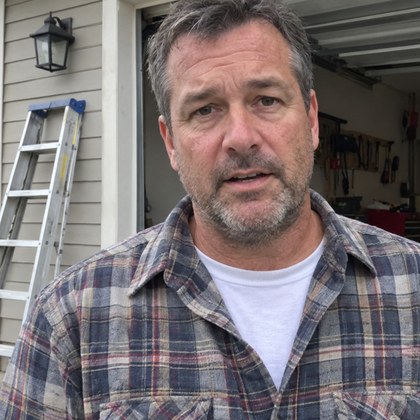
About Walt Cormier

Thirty-one years in the trade. Eleven of them on the morning-after call.

Walt Cormier
Walt Cormier · Dayton, Ohio

“The locks I sell are a small part of it.”

The first twenty years were the ordinary work of the trade — keys, safes, storefronts, cars, and letting people back into their own houses on Sunday nights. The rest has mostly been what we call post-entry work. Somebody has already been in the house. I am the man who comes afterward and makes it so it does not happen again.

That work changes how you see a street. After a few hundred of those doorways you stop looking at houses and start looking at the decisions somebody made about them, most of which were made by a builder in a hurry who was never going to live there. A three-quarter-inch screw where a three-inch screw belongs. A hedge that grew four feet past useful. A back door nobody has looked at since 1998.

A woman I will call Dolores hired me to change every lock in her house after a man in a work shirt talked his way into her basement and left with her husband’s watch. I did the work. Four hundred and ten dollars of good hardware on a house that already had good hardware. Driving home, I knew I had sold her something that would not have stopped one thing that happened to her. That was the afternoon I started making notes for these books.

I have stood in a great many front hallways with a great many people who felt foolish, and I want to say plainly that not one of them was foolish. Every one of them had been courteous at exactly the wrong moment, and somebody had come to their door counting on it.

— Walt Cormier, Dayton, Ohio
V

Questions

The ones I get asked most, answered the way I would answer them on a porch.

Are you a real locksmith, or is this repackaged internet advice?

Thirty-one years of it, in Dayton, Ohio. You will be able to tell inside two chapters, because the books are full of things that only come from standing in the doorways — the eleven houses on one street and which four got hit, the woman who spent eleven hundred dollars on hardware when the problem was a yew hedge, the fact that most meters in this country have been read remotely for years so the man in the blue shirt has no reason to be in your back yard.

The other tell is the limits boxes. There is one at the end of every chapter, saying what the fix does not do. An affiliate page does not write those, because they cost sales.

Your videos are free. Why would I pay for the books?

A video is four minutes on one fix. These are 734 pages with the parts lists, the 2026 prices to the dollar, the walk-around audit sheets, the shopping lists and the appendices — arranged in the order you would actually do them, and searchable on the phone in your hand while you are standing at the door in question.

And a good deal of it does not video well. Ninety chapters on doorstep scripts and telephone fraud is a reference you keep, not something you watch.

Why is it only $29.99? That seems low for four books.

Because there is no printing, no shipping, no warehouse and no middleman. The whole cost of giving you the fourth copy is the same as the first, which is nothing.

And frankly, the point of writing them was that nobody explains this to homeowners. A price that makes somebody think twice defeats the purpose. Four dollars of screws is the best fix in the set — it would be strange to gate it behind ninety dollars of book.

Does this teach anybody how to break into a house?

No, and that is deliberate. Nothing in these pages is a method for defeating a lock, a door or an alarm. Every technique is described at the level a homeowner needs in order to recognize it and stop it, and no further. Where a detail would be more useful to somebody committing these acts than to somebody preventing them, it has been left out on purpose.

I am not going to write a manual for the people I spent thirty-one years working against.

What format is it, and how do I get it?

PDF, illustrated, delivered instantly by Gumroad the moment you check out — a download link on screen and the same link by email. It opens on a phone, a tablet, a laptop or a Kindle, and it prints if you would rather have paper on the bench.

Instant download. Yours forever, on as many of your own devices as you like.

Can I buy just one of them?

Of course — every volume is $17 on its own, and there is a button on each one further up this page.

If you are not sure which, start with The Burglar-Proof Home Manual. It is the spine of the set. That said, all four together are $29.99, which is less than two of them, so the arithmetic tends to make the decision for people.

I rent. Is any of this any use to me?

Yes. 25 Cheap Upgrades has a whole appendix for renters, and a good share of the rest is free or reversible — sight lines, sash pins, dowel stops, window alarms, timers, the door scripts, the four o’clock lap. Where a job means a permanent change to the building, the text says so and tells you to ask first.

The chapter on rental locks and who else already has a key is worth the price of that book on its own.

I am buying this for a parent. Is that the right one?

How to Stop Being an Easy Target is written for exactly that reader, and it opens with a page called The First Saturday — five things, about a hundred dollars between them, that do most of the work in the whole book.

It is also written carefully. Nothing in it is meant to make anybody’s life smaller. If it leaves a person afraid to open their own front door, it has done them harm, and it says so on the first page.

Choose your volume

Any single book is $17. All four are $29.99.

Before you go

Four dollars of screws

That is the single highest-value fix in all 734 pages, and almost nobody has done it. The whole library is $29.99 today.

The Locksmith's Library — four volumes
$68 $29.99
Get the Complete Library
Instant download · Yours forever